Steve Khan's Lead Sheet for:
"Green Room"(Ralph Towner)
When I learned, just after January 18th, 2026, that my old friend, guitarist/composer Ralph Towner had passed away, it resonated deeply for me as Ralph had been one of the first musicians that I met and interacted with in 1970 after having moved here from Los Angeles. I then embarked down a path where I thought and thought about Ralph, listened to many of my favorite CDs and the music that he had written and performed and then began to write the TRIBUTE that is presented here below. Ralph left behind for us a real-life treasure trove of rich, sophisticated and moving music.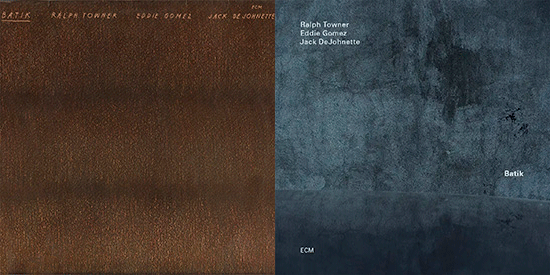 After his passing, suddenly in profusion, there were YouTube videos of classical guitarists, old and young, male and female, interpreting Ralph's pieces for the classical guitar. It was really wonderful and very touching. What greater tribute to this maestro could there be? I began to wonder aloud to myself, "Could I possibly come up with a fitting musical tribute to Ralph that could be heard as being worthy of the music that he leaves behind?" Throughout all of this, his magnificent 1978 ECM album, "BATIK", which featured Eddie Gómez and Jack DeJohnette kept coming back to me. I love all of Ralph's compositions on that album, but the rhythmical ballad, "Green Room" became ever-present in my mind and musical thoughts. As much as I had loved and enjoyed that piece and its performance on the album, I had never fully attempted to transcribe it or to really come to terms with understanding it. And so, the first step on the journey became taking the time and effort needed to write out a functional lead sheet that might help me to unlock some of "Green Room"'s secrets. It took seemingly forever to commit to a written version. That is how difficult it was. After his passing, suddenly in profusion, there were YouTube videos of classical guitarists, old and young, male and female, interpreting Ralph's pieces for the classical guitar. It was really wonderful and very touching. What greater tribute to this maestro could there be? I began to wonder aloud to myself, "Could I possibly come up with a fitting musical tribute to Ralph that could be heard as being worthy of the music that he leaves behind?" Throughout all of this, his magnificent 1978 ECM album, "BATIK", which featured Eddie Gómez and Jack DeJohnette kept coming back to me. I love all of Ralph's compositions on that album, but the rhythmical ballad, "Green Room" became ever-present in my mind and musical thoughts. As much as I had loved and enjoyed that piece and its performance on the album, I had never fully attempted to transcribe it or to really come to terms with understanding it. And so, the first step on the journey became taking the time and effort needed to write out a functional lead sheet that might help me to unlock some of "Green Room"'s secrets. It took seemingly forever to commit to a written version. That is how difficult it was.
As I went along, adding more details to my transcription, more questions would arise that remained so hard to answer. The piece was so melody-driven with harmony applied to and implied by those melodies that it became difficult to put chord names to some of the sonorities as they could pass by so quickly. Even now, with the project completed, I still question my own labeling of the chord symbols. But, they seemed to serve as, at the very least, functional for my harmonic bandmates on this adventure: Bendik Hofseth (Tenor Saxophone); Mark Egan (Fretless 5 and 8-string Basses); and Rob Mounsey (Orchestrations). Lucky for us all, 23 yr. member of Ralph's magical group Oregon, Mark Walker (Drums) with Bobby Allende (Bongó) adding his own special magical touches. When one studies and enjoys the broad artistic scope of Ralph's music and recordings, one can't escape his cosmic connections to Norway via his two monumental albums: the 1975 masterwork, "SOLSTICE"(ECM) and 1977's "SOUND AND SHADOWS"(ECM). The contributions that saxophonist Jan Garbarek and drummer Jon Christensen brought to Ralph's music are almost impossible to measure, but the impact of those recordings would be felt worldwide, and, in fact, they are still being felt today. German bassist Eberhard Weber has to be mentioned and acknowledged here as well.
Believe it or not, my own connection to Norway and Bendik Hofseth, now to be Knighted by King Harald and receive the Royal Norwegian Order of Merit, came to my mind in a dream which was induced, no doubt, by months of enduring an upper-respiratory nightmare. In the dream, Bendik's name, voice, sound and artistry came to me, and when I awakened, I knew immediately what I had to do and how that choice or decision would affect what, in the end, "Green Room" would come to sound and feel like.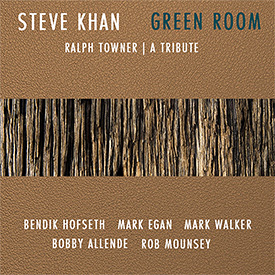 Bendik and i played together with Mike Mainieri's Steps Ahead on the two albums "N.Y.C."(1989) and "YIN-YANG"(1992). My lasting memory is of playing Bendik's composition, "Absolutely Maybe." When we played that melody together, I felt an immediate kinship, personal and musical with him that was so organic and natural that it became unforgettable for me. Playing a melody like that, one that breathed and was so elastic and flexible, was not something that one forgets. So, after so many years, to reunite with Bendik for this Tribute to Ralph Towner seemed like the perfect fit. Before that dream, I was thinking along the lines of having a pianist play on the piece, something that is very rare for me. A couple of names came to mind - but there would be delays involved with them. And so, that sense of a pause allowed me to think of Bendik - and so, here we are. Bendik and i played together with Mike Mainieri's Steps Ahead on the two albums "N.Y.C."(1989) and "YIN-YANG"(1992). My lasting memory is of playing Bendik's composition, "Absolutely Maybe." When we played that melody together, I felt an immediate kinship, personal and musical with him that was so organic and natural that it became unforgettable for me. Playing a melody like that, one that breathed and was so elastic and flexible, was not something that one forgets. So, after so many years, to reunite with Bendik for this Tribute to Ralph Towner seemed like the perfect fit. Before that dream, I was thinking along the lines of having a pianist play on the piece, something that is very rare for me. A couple of names came to mind - but there would be delays involved with them. And so, that sense of a pause allowed me to think of Bendik - and so, here we are.
Electric Bassist Mark Egan and I have been good friends and musical colleagues since the '70s, and I have been an extremely proud participant in several of Mark's Elements recordings and road gigs. This is a group that included: co-leader Danny Gottlieb (Drums) Clifford Carter (Keyboards); and Bill Evans (Saxophone). Lots of great memories making music together. When I was conceptualizing the arrangement and the sound and feeling that I wanted the piece to convey, I immediately thought of Mark's fretless bass sounds, because there is really no one like Mark Egan! When I thought about the Outro for the piece which blends into a Fade, I could hear Mark's special usage of rhythmic harmonics, generated from his Pedulla 8-string fretless bass. From the Elements catalog, classic songs that immediately came to mind were: "Color Wheel" and "Romper Room." Mark brought these sounds and his wave to "Green Room" beginning at the 4th Repeat of what I labeled as Letter [F]. When you blend these harmonics with drummer Mark Walker's flat Paiste ride, it brings to mind an aspect of the feeling created on "Oceanus" from the "SOLSTICE" album. Though the tempos are not really similar, one can imply the same feeling and vibe - IF you have the right players.
Drummer Mark Walker was a perfect choice for me to be a part of a TRIBUTE TO RALPH TOWNER via an interpretation of "Green Room" because, as I have already mentioned, Mark was a 23 yr. member of Ralph's group, Oregon, recording with them and traveling the world. His closeness to Ralph and Ralph's music is obvious. When this idea was first hatched, I communicated with Mark right away. Our own musical connections go back to the Caribbean Jazz Project and then, in 2016, Mark was a huge part of my "BACKLOG"(Tone Center) recording. He brings with him to this project deep levels of sensitivity and creativity that all come into play during this performance. His musical interaction with all of the players within the context of the arrangement that I created could not have been better. I am very grateful for everything that Mark Walker brought to this piece and the end result.
With Bendik's involvement in place, I completely let go of other possible ideas relative to instrumentation, principal amongst them was having an acoustic piano. So knowing this, I set out to create a texture that would honor Ralph's original version of "Green Room," but one that would also bring something unique to the piece. With that in mind, I attempted to create a vibe via a sandwich of guitar sounds. The main voice of the piece would be my Martin MC-28 Acoustic 6-String guitar. And I was hoping that, once I had unearthed my David Russell Young Acoustic 12-String from the closet, this beautiful instrument would become a color, like Ralph's Guild acoustic 12-string, throughout.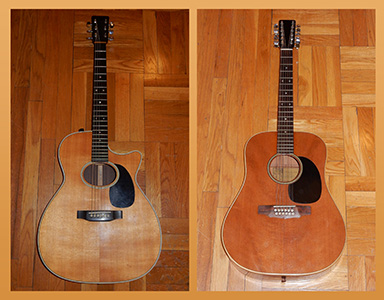 However, not having seen this instrument in decades, I was worried that my memory of it, and its construction, would reveal the problems of the past. And, sure enough, once out of the case, I could see that the instrument had been made without an adjustable truss-rod. And so, with the changes of season here in New York, the action was sitting so high up that I actually could not play the guitar like normal! However, I was not going to allow this to defeat me from using its colors in a Towner-esque manner. By that I mean, that I would have to create some 15 different tunings in order to produce colorful harmonics to embrace Ralph's spirit throughout. It took a tremendous amount of work and preparation but, once completed, I was really pleased with the results and, at the very least, the instrument did record beautifully despite its physical problems. In concept, the idea would be that these two acoustic instruments would sound as if they had been played at the same time, switching back & forth when, of course, that would be impossible to do. With engineer Malcolm Pollack's expertise in mixing, we were able to marry these two guitars into a part of this sonic sandwich. The last ingredient for this sandwich of guitar sounds would be my by now familiar ESP Strat Orchestrations performed direct into the console with not much more than a volume pedal, my trusty Ibanez DCF-10 Chorus pedal, and the subtle usage of my Whammy bar, or the "Soul Stick" as one old friend used to call it. But, the colors and motion of Ralph Towner's harmonies within "Green Room" presented a formidable challenge. However, not having seen this instrument in decades, I was worried that my memory of it, and its construction, would reveal the problems of the past. And, sure enough, once out of the case, I could see that the instrument had been made without an adjustable truss-rod. And so, with the changes of season here in New York, the action was sitting so high up that I actually could not play the guitar like normal! However, I was not going to allow this to defeat me from using its colors in a Towner-esque manner. By that I mean, that I would have to create some 15 different tunings in order to produce colorful harmonics to embrace Ralph's spirit throughout. It took a tremendous amount of work and preparation but, once completed, I was really pleased with the results and, at the very least, the instrument did record beautifully despite its physical problems. In concept, the idea would be that these two acoustic instruments would sound as if they had been played at the same time, switching back & forth when, of course, that would be impossible to do. With engineer Malcolm Pollack's expertise in mixing, we were able to marry these two guitars into a part of this sonic sandwich. The last ingredient for this sandwich of guitar sounds would be my by now familiar ESP Strat Orchestrations performed direct into the console with not much more than a volume pedal, my trusty Ibanez DCF-10 Chorus pedal, and the subtle usage of my Whammy bar, or the "Soul Stick" as one old friend used to call it. But, the colors and motion of Ralph Towner's harmonies within "Green Room" presented a formidable challenge.
On the original ECM recording of "Green Room," Ralph played both acoustic piano and acoustic 12-string. it seems fairly apparent that he would have played the piano live with Eddie and Jack and then, overdubbed the 12-string. With his piano having stated all of the melodic material, the 12-string brings wondrous additional harmonies, plus those harmonics splashes and, of course, a solo section. Their Outro on this version features interplay from both of Ralph's instruments alongside Eddie and Jack. Once I had notated the melody reasonably well, I attempted to analyze the harmonies that colored those notes. In many cases, the blending of the piano and the 12-string created clusters that became other-worldly harmonies. So while trying to come-up with decent chord symbol indications, I had to try to figure out just how on earth I could capture some of these sonorities with my Strat Orchestra - and not feel as though the harmonic space would have to also be augmented by some kind of keyboard, or better yet, perhaps Rob Mounsey's orchestrations? As I have been saying, I simply did my best to create this sandwich of guitars to come together and paint a single, very broad-based, portrait - an impression of Ralph Towner's "Green Room."
If we are looking at my transcription of Ralph original version of "Green Room," I only assigned 3 letter markings, those being: [I] for the Intro; Letter [A] for the main body of the 17-bar wandering melody and Letter [B] for the fascinating "bridge" or contrasting section. If I was revising what I wrote, I would now add a Letter [C] for the Outro which becomes a beautiful Fade. Sometimes a board fade is the perfect solution for when a specific "ending" is not conceived of and written. If effective that Fade makes the listener wish that the music had never ended and wonder: "What happened if the Fade kept going?" Generally speaking, I don't like to use traditional key signatures because I find that most contemporary music, Jazz specifically wanders through a variety of tonal centers, however brief they might be. So, to have concluded that "Green Room" is in C minor, I believe would give a false impression. As it should, the Intro [I] sets the mood and it is filled with beauty, mystery and kind of tension as Eddie Gómez' acoustic bass is peddling 'C' and Jack DeJohnette's brushes are rustling around.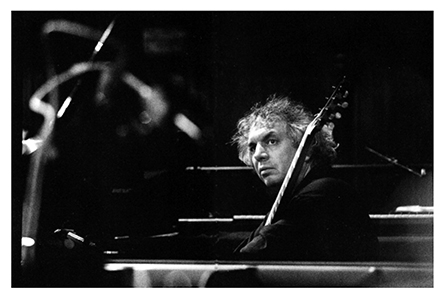 Ralph's piano and 12-string go back-and-forth between a very simple C minor chord, often with no more than the notes from the basic triad and an Fm9/6 over C. When [I2], the 2nd 8-bars of the section, the key melodic movement is between Eb for Cm and D-natural for the Fm6/9 chord. There is often such great beauty in the simplest of linear movements. Ralph's piano and 12-string go back-and-forth between a very simple C minor chord, often with no more than the notes from the basic triad and an Fm9/6 over C. When [I2], the 2nd 8-bars of the section, the key melodic movement is between Eb for Cm and D-natural for the Fm6/9 chord. There is often such great beauty in the simplest of linear movements.
When [A] arrives Ralph's melody seems to be so singable and yet it is incredible difficult because there are so many moments of chromaticism. For example, the chromatic lower neighbor C-natural going up to C# in bar 3. The chromatic upper and lower neighbors surround D-natural in bar 6. And then in bar 7, you have the motion of B-natural to Bb over the G7(alt.) chord, eventually landing on a lower Bb for a 2-bar pause with Eb/E as the chord. At bar 10, Ralph gives us the mystery of Spanish-flavored Phrygian mode through the Cm9/D chord, as I choose to label such things. But, there are special Ralph Towner colors to come as the melody takes us through B/D and eventually, Eb/D (very similar to Cm9/D). In bars 15-16, Ralph reprises a part of the melodic movement that we heard in bars 7-8, but this time some of those melodic notes, they dance through Dmaj7#5 (F#/D) before arriving at the G7(alt.) chord and finally, a Gmaj7#5 (B/G) sound. It was only recently that I was able to hear this major7#5 sounds. Sometimes, it just takes some time and space to better hear a composition in all its details. These 17-bars of melody are a most miraculous journey falling within this rhythmic ballad.
Though most [B] section in songs are designed to be a relief from what has come before, this rather brief [B] section only deepens all of the mysteries. In essence, we have a rather strange/unique 3-bar phrase that is repeated 3 times with differing beat extensions which are hard to determine if they were actually written one way or another way. I just tried to notate what I heard as they went by. What a marriage you have hear of melody, harmony and an active and very melodic bass line. Melodically, you have a journey from Bb through B-natural, to D-natural to Eb. Each destination point colored by Eb/E to G/F to G/Ab and eventually a sonority that is difficult to label because the bass is moving from a low B-natural up to Ab and cluster between the piano and acoustic 12-string that can sound to me like Abm9(maj7). To these ears, Ab melodic minor [Ab, Bb, Cb, Db, Eb, F, G] sounds like the correct scale/mode for this sonority.
When it came to chord labeling, the big trouble spot for me was actually in bars 5-6 of [A]. The one thing that was always clear to me was that Eddie's bass moved from A-natural in bar 5 down to Ab in bar 6. That should help, right? Initially, in bar 5, I had labeled that chord as Dm9/A, but as time passed and those bars would go by, that chord symbol just didn't feel right to me. At one point, on the original recording, I heard Ralph's acoustic 12-string play on the bass strings, A-E-B, and he gently slid up from E to F. That one little moment caused me to change my own chord symbol for that bar. I felt that the F was actually lower in register to capture the sonority. So, I came to label that chord as G7(9/13)/A. But, bar 6 remained a problem bar for me. What was going on there? As you can see on my original lead sheet transcription, I had that chord labeled as Fm/Ab - not the worst of chord symbols. Then, for a time, I thought that the chord actually sounded more like something related to Abmaj7(6). But that didn't feel right to me either. Eventually, and especially after having transcribed my acoustic guitar solo, I could hear/see what I had been hearing as the chord via my lines. Now, I choose to label the chord in bar 6 as Dbmaj7/Ab. Even in my discussions about his possible orchestral touches, the great Rob Mounsey even found these bars to be puzzling, and for a great musician like Rob to be puzzled by anything is very strange to me. Eventually, after offering my adjusted ideas for those bars, we came to see things in a similar way. I'm grateful for that. Where the perception of harmony is concerned from Ralph's original version comes, there were moments when the acoustic piano and Ralph's acoustic 12-string would me somewhere and there would be spontaneous blending of harmony that was at once beautiful but confusing. In the end, this is just a small part of the glorious mysteries contained in Ralph's compositions.
In the original version, much like most of the great Jazz traditions, one is expected to improvise over the form of what was stated melodically. As Ralph was playing acoustic piano on the basic performance, the three solos went in this order: acoustic 12-string; acoustic bass and lastly acoustic piano. At the end of Ralph's piano solo, he states the [B] section, and within he plays a wonderful interval of a 3rd, spelling up, D-F-natural. A subtle detail that turns the section around. Finally, the piece returns to Letter [A] and this last time after [B] is also reprised, we take a Coda which gives us a 2-bars of transition chords: G/Gb w/ G-natural on top to Eb/F w/ Eb on top landing on an Em9(sus) chord w/ E-natural on top, and the Outro is upon us. Ralph is, in essence, in a musical dialogue with himself: acoustic piano and 12-string and, of course, Eddie Gómez is a big part of this conversation while Jack DeJohnette has now switched to sticks and slowly raises the intensity level. As the section moves along, you hear Ralph playing a brief plagal cadence from Am to Em which cements the sense that they were improvising in E Aeolian mode [E, F#, G, A, B, C, D]. So, there you have it, this is essentially how Ralph Towner laid out "Green Room" for his bandmates on "BATIK" in 1978.
It is a bit rare for me to be looking at lead sheets for both an original version and then my own arrangement of said, but that is what seemed to be the best approach here. In general, much of what I did within the context of my own treatment of "Green Room" echoes Ralph Towner's original. For example, I also chose to begin with a 16-bar Introduction, labeled as [I] and [I2], 8 bars each. Here I tried to establish the sounds of the two acoustic guitars plus my Strat Orchestrations. I felt that it was important to do this because there would be no acoustic piano within my arrangement. In Ralph's original, his piano really carries most of the melodic weight joined by his acoustic 12-string at times. 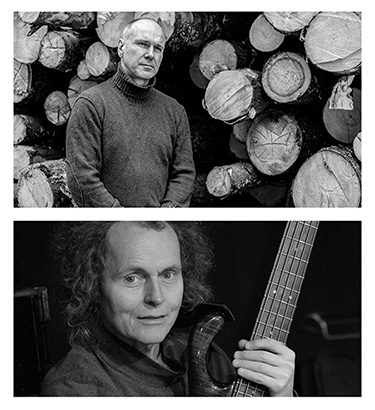 I chose to present the melodies with my acoustic 6-string carrying the melodies joined by Bendik Hofseth's beautiful tenor sax. During the process of getting Bendik recorded from Oslo, Norway, our communications were not in any way of the immediate variety - spotty e-mails at best. But, from the outset, I tried to communicate to Bendik that he should just phrase Ralph's melodies as he felt them, not so much as I had written them out or interpreted them myself. I was not looking for a particular kind locked-in glued-together approach to phrasing. The end result is that we were able to have a kind of looseness together which, for this piece of music, I like very much. I chose to present the melodies with my acoustic 6-string carrying the melodies joined by Bendik Hofseth's beautiful tenor sax. During the process of getting Bendik recorded from Oslo, Norway, our communications were not in any way of the immediate variety - spotty e-mails at best. But, from the outset, I tried to communicate to Bendik that he should just phrase Ralph's melodies as he felt them, not so much as I had written them out or interpreted them myself. I was not looking for a particular kind locked-in glued-together approach to phrasing. The end result is that we were able to have a kind of looseness together which, for this piece of music, I like very much.
One structural addition that I made was that I chose to reprise the first 4-bars of [A] after a full statement of the melody that being [A] and [B] through [B3] and it is at that point that we hear [A2]. That same [A2] appears as a melodic reprise after each of the 3 solos. Those being my acoustic guitar solo; Mark Egan's fantastic fretless solo; and lastly Bendik's tenor sax solo. After Bendik's solo, I had him weave into a brief restatement of the [B] melody before we D.S. back to [A]. In the last bar of that Coda section, as another small tribute to Ralph, I played a quote from his tune, "C.T. Kangaroo" from his album 1983 ECM album, "BLUE SUN." "C.T." is a gesture of love from Ralph to his daughter Celeste, Celeste Towner. I quoted a brief motif that Ralph played on both trumpet and French horn. From that point, we follow Letter [A] into [B] and then take the Double Coda which brings us to Ralph's 2-bar transition into a key area change landing on Em9(sus) with the same Aeolian mode feeling. Within that transition, you have a bass line that is descending: Gb-F-E. I labeled the first chord as G/Gb, but the more that I think about that chord, its sound and its direction, I think that I should have labeled it G/F# because that would be more in keeping with the fact that we are headed to Em7.
Within my arrangement, Ralph's Outro section which lasted for 2-minutes becomes my Letter [F] and our Outro lasts some 3-minutes. Each "section" of [F] lasts 8 bars. In my case, I tried to shape the arc of the section in ways that might prolong the state of flow and space while adding some points of interest. Part of the concept was to allow drummer Mark Walker to make the transition from stately brushwork to sticks and the pinging of cymbals. As I mentioned earlier, while singing the praises of bassist Mark Egan, I had planned that at [F4] there would be shift in the motion of the section and the piece. Here, Mark Egan would begin to play his very special brand of harmonics on his Pedulla 8-string bass and as they percolate beneath everything, Mark Walker adds in the pinging of his majestic Paiste flat ride. This whole "vibe" or "wave" continues until we have faded out. This is also another subtle tribute to Ralph Towner that calls to mind, at least for me the title track from the "BATIK" album. Within this section, I also threw in two quotes from the melody of Ralph's "Waterwheel." They are easy to miss, but they are there. All the while, Bendik's tenor sax weaves in, out and around the sandwich of guitars. I would also want to point out that at two points during this Outro, both Mark Egan and I state the 1st 2-bar phrase of Ralph's "Green Room" melody in this new key area to give a kind of important thematic continuity to everything. Within any arrangement, small details like this provide something that can be important for any listener, even if on a subliminal level.
When I first began to conceive of this Tribute to Ralph Towner via an interpretation of his composition, "Green Room," drummer Mark Walker was actually the 1st person that I thought of. As a musician, as a drummer, he has the kind of scope, sensitivity and experience to be a part of something like this. He has the kind of artistry on brushes to carry a rhythmic ballad for 6-minutes plus if necessary.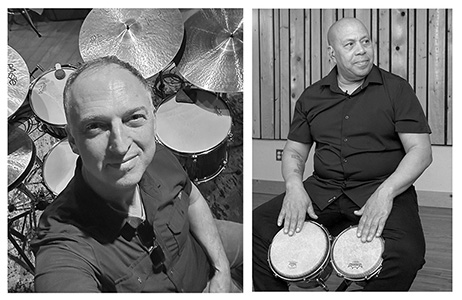 The structural oddities of this particular song would never be a problem for Mark. Of course, the biggest detail in Mark's body of work was his 23+ year musical and personal relationship/friendship with Ralph Towner as the 4th member of Oregon. That experience brings with it a kind of depth that is beyond just any particular collection of musical experiences. The travel, the bus rides, car rides together. The breakfasts, lunches and dinners together. So much time together for a deepening understanding and finding commonality in many things. Those moments contribute to making the musical understanding so much deeper. And Mark Walker brought all of that and more to his one performance. Throughout the process of getting this musical project to see the light of day, Mark was a constant source of positive energy and creative reinforcement. I am very grateful for all of that. As the arrangement and its sound design were coming into focus for me, I suddenly realized that our "Green Room" would benefit greatly from the presence of master percussionist, Bobby Allende and here his bongó. We have been working together on projects for some 30+ years and over that time, we have come to an understanding how we can best communicate and work together to achieve ONE goal. Bobby and Mark Walker had also worked together, in tandem, on my 2016 album, "BACKLOG"(Tone Center). Bobby gave the piece a kind of distinctive flavor and sabor, if you will, that it would not have had otherwise. Not only does the sound of flesh on skin provide tones that hadn't been there, but add a rhythmic percolation benefits the overall piece and presentation. Bobby's performance and musicality also serves as he becomes the commentator on all of the other performances by offering reactions to what he hears. These very things are what I knew that he would bring to our Tribute! I'm so glad that he was on board for this. The structural oddities of this particular song would never be a problem for Mark. Of course, the biggest detail in Mark's body of work was his 23+ year musical and personal relationship/friendship with Ralph Towner as the 4th member of Oregon. That experience brings with it a kind of depth that is beyond just any particular collection of musical experiences. The travel, the bus rides, car rides together. The breakfasts, lunches and dinners together. So much time together for a deepening understanding and finding commonality in many things. Those moments contribute to making the musical understanding so much deeper. And Mark Walker brought all of that and more to his one performance. Throughout the process of getting this musical project to see the light of day, Mark was a constant source of positive energy and creative reinforcement. I am very grateful for all of that. As the arrangement and its sound design were coming into focus for me, I suddenly realized that our "Green Room" would benefit greatly from the presence of master percussionist, Bobby Allende and here his bongó. We have been working together on projects for some 30+ years and over that time, we have come to an understanding how we can best communicate and work together to achieve ONE goal. Bobby and Mark Walker had also worked together, in tandem, on my 2016 album, "BACKLOG"(Tone Center). Bobby gave the piece a kind of distinctive flavor and sabor, if you will, that it would not have had otherwise. Not only does the sound of flesh on skin provide tones that hadn't been there, but add a rhythmic percolation benefits the overall piece and presentation. Bobby's performance and musicality also serves as he becomes the commentator on all of the other performances by offering reactions to what he hears. These very things are what I knew that he would bring to our Tribute! I'm so glad that he was on board for this.
In order to create a working texture for myself to play to initially, I had to use simple keyboard ideas to support what I had in mind for the guitar soundscape that I was hearing. Once I had the guitars reasonably in place within the format and structure that I had create to honor Ralph Towner's "Green Room," the other players could be added in with a level comfort and freedom. All along my plan was to gradually eliminate those early keyboard sounds and textures and hope that the harmonic support would still be there.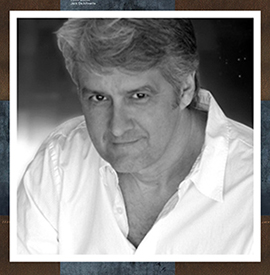 As the arrangement and the music began to grow, I felt that I was going to need the musical help from my most trusted colleague, keyboard and musical giant, Rob Mounsey. First, I sent Rob an mp3 of Ralph's original version of "Green Room" which he really liked and found the harmonies to be complex, and even, for him - one of the greatest musicians that I know - mystifying. When I sent him an mp3 of an early rough mix that I had done of my interpretation that then only included Mark Egan and Mark Walker, Rob was not at all certain as to just what or how much he could add, from an orchestral standpoint, to not overly complicate what was already there. I assured him that anything that he heard or felt would be welcomed by me. Once Bendik and Bobby had performed, I sent Rob everything and let him live with it for a bit. When we reconvened on the phone one day, he asked me for a 'list' suggested places within the arrangement that I heard a need for something - and so, I made a bit of list - a small one - suggesting some spots. Then, I just returned to the patiently waiting mode to see what Rob would eventually come-up with. As the arrangement and the music began to grow, I felt that I was going to need the musical help from my most trusted colleague, keyboard and musical giant, Rob Mounsey. First, I sent Rob an mp3 of Ralph's original version of "Green Room" which he really liked and found the harmonies to be complex, and even, for him - one of the greatest musicians that I know - mystifying. When I sent him an mp3 of an early rough mix that I had done of my interpretation that then only included Mark Egan and Mark Walker, Rob was not at all certain as to just what or how much he could add, from an orchestral standpoint, to not overly complicate what was already there. I assured him that anything that he heard or felt would be welcomed by me. Once Bendik and Bobby had performed, I sent Rob everything and let him live with it for a bit. When we reconvened on the phone one day, he asked me for a 'list' suggested places within the arrangement that I heard a need for something - and so, I made a bit of list - a small one - suggesting some spots. Then, I just returned to the patiently waiting mode to see what Rob would eventually come-up with.
For me, though I am not blessed with infinite patience, I know that it is always best to leave Rob to his work and he will get to this project when he can. As things turned out, he began to send me his fantastic orchestration ideas in file form and thus began the process of some back & forth as we were able to make small refinements as we went along. I took some time and sat down at my computer and wrote out some places within the arrangement that I felt would benefit from Rob's textures. All the while, we simply trying to enhance what is essentially a quintet piece made up of guitars; bass; drums; tenor sax and bongó. The colors that Rob added would include: [1] Flügelhorns; [2] Flutes; [3] Harps; [4] Marimbas; [5] Pizzicato Strings; [6] String Trills; and lastly, [7] Low String Sustain. Seems like a long list but in truth the usage is very minimalist. These colors appear add something of meaning and then disappear. I enlisted Rob's aid in coloring the acoustic guitar quotes from both Ralph's "C.T. Kangaroo" and "Waterwheel" - both turned out just as I had imagined. In the extended [Outro] and [Fade], Mark Egan's fretless bass quotes the main theme and later on, my acoustic guitar quotes that same theme. I asked Rob to please color these moments too. And he did this with those aforementioned flutes.
With Rob's wonderful contributions completed, it was time to turn everything over to engineer Malcolm Pollack to mix the piece. Malcolm and I have been working together for some 40+ years and we have established a very good communication style to produce good results. I always begin with trying to convey that I want the piece at hand to sound BIG & WARM. I have never liked it when some engineers want to add a little sparkle or fairy dust to the upper frequencies which, to these ears, can make a performance sound brittle or abrasive - I want to stay as far away as I can from that kind of audio presentation. Malcolm started by sending me his 1st mix impression of the piece and we went from there making adjustments, none too drastic, and 11 revisions later? I found that I was very pleased with what we had. Malcolm, once again, did a beautiful job and I am very grateful. Then, thanks to another old friendship and longterm business relationship with Sterling Sound, I was able to get Steve Fallone to do the mastering for me. What are my usual instructions for mastering? It is pretty simple, to Steve or, in the past to Greg Calbi, just make it sound "BIG & WARM!" Usually, when a mix is done and I have signed-off on it, I am never trying to save some part of it with mastering! So that is never an issue or goal. I also tell the engineer that I don't want any extra sparkle or fairy dust add to the tippy-top frequencies which can make aspects of some instruments sound harsh and brittle. Making a beautiful and eminently listenable recording is always the greater goal. To me, what a great mastering engineer does is find some frequencies in the great audio middle that someone aerate the mix as a whole. When one hears this, it really is magical! Lastly, I am not looking to have the loudest song available. I realize that some artists and producers have been driven to think this way, but I, for one, am not one of them. Not at all. Whatever eventual level Steve Fallone arrived at? That's going to be perfectly fine for me, and fine for platforms like YouTube, Spotify and iTunes/Apple Music.
Though Ralph Towner and I had already recorded together on February 5th, 1972 for a Clive Stevens "ATMOSPHERES"(Capitol) album which featured: John Abercrombie (Guitar); Rick Laird (El. Bass) and Billy Cobham (Drums) and Ralph on Fender Rhodes. That album was not released until 1974. But I had noted in that same Datebook that Ralph and I spent some time hanging out, playing music and beginning to become good friends on June 22nd of 1972. That friendship only deepened as the years went by.
One of my favorite shared moments with Ralph took place at Carnegie Hall on September 19th, 1975, a concert that featured the Barney Kessel Trio; Ralph Towner Solo and Larry Coryell with Steve Khan in Duet. What I remember most about that night is that Ralph seemed really glad to see me backstage, and we spent a good deal of time together talking, laughing and reminiscing about everything. My lasting impression of that night was two-fold: [1] Ralph was just chain-smoking like a maniac. He would have barely finished one cigarette and he was already lighting up the following one. It was incredible. He seemed to be wound up and nervous, lots of nervous energy backstage. But then in sharp contrast, [2] Ralph took the stage, and simply played like an angel, so calm, composed, reflective - total magic! I just said to myself, "Man, now that is an artist!" It was so inspiring.
From 2000, Anil Prasad did this wonderful interview with Ralph which he titled, "Unfolding Stories." And then, in 2017, Anil revisited with Ralph and presented a very comprehensive piece which he titled: "Magic and Affirmation." It you are looking for in depth looks into Ralph Towner as a human being and his approach to his instruments and music-making? These are the resources that you must access. If you take the time to read them both, you will come to know the great Ralph Towner in a far more profound way!
I am left to hope that anyone who has visited this page, read the text, listened to our humble interpretation of "Green Room" that you have come to feel and understand something about Ralph Towner's composition and the creative process here that sought to bring a different take on it to life and shine a light on a great piece of music. The journey and the end result came to mean a lot for all of us. Wishing everyone good health, good fortune and the will to pursue your dreams no matter how difficult or far away they might seem.
- Steve, New York City, May, 2026
Again, as I sit here today, what I wrote just below was written 21 years ago when I was 58 yrs. old, so if anyone is reading this, imagine how I feel right now at 79 yrs. of age. Back then, I was writing about just how much shorter my green field was. As I mused about it then, I really could not have known that I would even be around to experience just how much shorter it actually looks to me now. With the passing of so many dear friends, family members, musical compatriots, it becomes remarkable that I can sit here and even think about such philosophical things. More to the point, with the recent losses of both Jack DeJohnette and Anthony Jackson all such things are felt more deeply.
Below what I wrote about my green field, for those of you who might have missed it, I have added in to this page my TRIBUTE to Ralph Towner which was initially posted on January 20th, 2026.
The notion of a "green field" was born during a discussion with an old and dear friend about "death" or, perhaps better said, about the sense of "loss." I have never viewed myself as a particularly profound person, especially when speaking extemporaneously, but, in that moment I guess I just got lucky when I stated something resembling the following:
"....When one is in their 20s, as we look ahead, far into life and the future, as we can see it from that perspective, the green field which lies ahead of us seems endless, and so full of possibilities and dreams. But, as one grows older, one experiences loss in all its varied forms, divorces and separations, sadly seeing your parents pass away, seeing one's friends and contemporaries die around us(sometimes even those considerably younger), the view of the green field changes. Suddenly, it is a much shorter green field, and the opportunities that remain must be guarded and treasured in a far different manner, and, from a perspective of greater maturity and wisdom. At least we can hope for that.
Like anyone else, perhaps, I fear a prolonged and/or painful death, but, death in and of itself, I do not fear. I don't know that one ever gets to do, or accomplish all that they would like, but, for my part, I have led a rich life, often times filled with beautiful and wonderful people. If it were all to end tomorrow, I could never feel cheated by anything, nor anyone, for I know that I have been a lucky man, and will leave behind my good work, and even some good deeds."
And so, in that spirit, I would say to all of you, take advantage of what is in the now, don't belabor the past, and don't spend unnecessary energy worrying about the future. But, do plan for it, in order to make use of it. For all that Bendik Hofseth; Mark Egan; Mark Walker; Bobby Allende and Rob Mounsey gave to this performance of Ralph Towner's "Green Room," I can only hope that, at least once, you will choose take 8:18 of your life, and devote it to listening to this performance. It has become, even if unexpected, a highly significant moment in my musical life, in my life. I hope that it can contribute something intangible to yours. Thank you so much for listening!!!
As always, my most sincere "Thank you!" to everyone who visits these pages with regularity. PEACE, LOVE and ETERNAL FLOWER POWER!!! All so very much needed in these dark times - Steve
As sad as I am to now mark the passing of a musical giant, Ralph Towner, I am simply honored and humbled that he and I were friends almost since my arrival in New York in 1970. Ralph was one of the first musicians that I met here. At that moment, I sadly knew very little about just what kind of a musician, guitarist and innovator he actually was.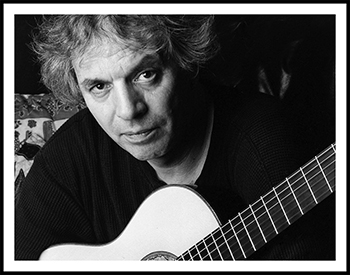 In music and in the business of trying to reach people through music, the only reason that musical genres and categories come to exist is because music business people, record executives, etc. need categories especially from the '50s through the '80s when there were still record stores, later CD stores. LPs/CDs needed to be placed in a "section" so that music fans could find what they were seeking. Though at the time, we couldn't have known it, Ralph would be involved in music that would defy categorization, and it would be as if he was inventing "World Music" or "New Age" music before such a label was put on the music that he created as part of the Paul Winter Consort (1970-72), and then, soon there after as the founder and co-leader of the futuristic group Oregon which brought together: Paul McCandless; Glen Moore and Collin Walcott. How well I remember their earliest albums that included: "MUSIC OF ANOTHER PRESENT ERA"(1972) and "DISTANT HILLS"(1973). Even after Collin's sad passing in 1984 while only 39 yrs. of age, Ralph, Paul and Glen would keep the group's music growing and alive with magnificent and highly individualistic contributions from Trilok Gurtu in 1986 for 3 albums, and then Mark Walker in 1997, essentially to the present. Beyond Ralph's singular mastery of the classical guitar and his acoustic 12-string, he played the piano like his hero, Bill Evans - later adding the synthesizer to his arsenal of sounds. Not to mention that Ralph could play the trumpet and the French horn. Thus making Ralph Towner a musician and conceptualizer unlike anyone else - he was a visionary! In music and in the business of trying to reach people through music, the only reason that musical genres and categories come to exist is because music business people, record executives, etc. need categories especially from the '50s through the '80s when there were still record stores, later CD stores. LPs/CDs needed to be placed in a "section" so that music fans could find what they were seeking. Though at the time, we couldn't have known it, Ralph would be involved in music that would defy categorization, and it would be as if he was inventing "World Music" or "New Age" music before such a label was put on the music that he created as part of the Paul Winter Consort (1970-72), and then, soon there after as the founder and co-leader of the futuristic group Oregon which brought together: Paul McCandless; Glen Moore and Collin Walcott. How well I remember their earliest albums that included: "MUSIC OF ANOTHER PRESENT ERA"(1972) and "DISTANT HILLS"(1973). Even after Collin's sad passing in 1984 while only 39 yrs. of age, Ralph, Paul and Glen would keep the group's music growing and alive with magnificent and highly individualistic contributions from Trilok Gurtu in 1986 for 3 albums, and then Mark Walker in 1997, essentially to the present. Beyond Ralph's singular mastery of the classical guitar and his acoustic 12-string, he played the piano like his hero, Bill Evans - later adding the synthesizer to his arsenal of sounds. Not to mention that Ralph could play the trumpet and the French horn. Thus making Ralph Towner a musician and conceptualizer unlike anyone else - he was a visionary!
How well I remember the first time that I heard Weather Report's second album, "I SING THE BODY ELECTRIC" and hearing Ralph's one-minute and forty second solo acoustic 12-string introduction to Wayne Shorter's piece, "The Moors." I remember hanging out with Ralph one afternoon in my uptown basement hovel of an apartment and telling him just how amazing I thought that that was..... and then, Ralph proceeded to tell me that he didn't even know that Joe Zawinul was recording what Ralph thought was his mic test, and the next thing Ralph knew was that Joe was telling him how great what he had played was, and that he could go home - they had what they needed. Ralph couldn't believe it - nor could he believe that that moment would become an iconic moment in Jazz/Fusion history. This introduction still sounds incredible to me, and perhaps it served as some kind of precursor to what Ralph's solo acoustic guitar concerts would become over time?
How well I remember a concert @ Carnegie Hall on Friday, September 19th, 1974 which featured Ralph Towner, solo guitar; Larry Coryell and I in our acoustic duo setting; and the Barney Kessel Trio. By then, Ralph and I were already good friends, and on that night, I spent far more time with hanging and talking with Ralph than I did with Larry. I remember watching Ralph chain-smoke cigarettes like a maniac - barely finished one before lighting up another. In that moment, I thought to myself, "If he is that nervous, how is he ever going to be able to play?" And of course, when it came time for Ralph to open the concert, he walked out onto the stage and played like some kind of magnificent angel. It was remarkable. I don't remember much else, because I was probably so nervous about what Larry and I were going to attempt to do, that I was solely focused on that.
Somewhere during this same time period, Ralph told me about how his guitars were stolen right out of the back seat of his car while it was parked in the West Village. I think that the car was a Volkswagen. At the time, everyone was so upset about this, that it could happen to someone like Ralph, that the community of musicians was putting out feelers to see if we could get his guitars back. But, it never happened. I think it was one of those stories where Ralph had just left the car unattended but locked for a few minutes, and he came back and 'poof' his prized guitars were gone.
It was not that long afterwards that Ralph would find himself in the musical company of: saxophonist Jan Garbarek and the rhythm section of Eberhard Weber and Jon Christensen to record the 1975 masterwork, "SOLSTICE"(ECM). This blending of musical cultures and sensibilities would pave the way for a broader musical melding of both European and American traditions into something completely new and different that influence generations of musicians. Ralph Towner was at the forefront of all of this. Ralph Towner was at the forefront of all of this.
I often try to tell younger musicians about Ralph's 1978 album, "BATIK"(ECM) which featured Eddie Gómez and Jack DeJohnette. Though the title piece has its roots in the spatial nature of "SOLSTICE" - the other songs are each wonderful in their own way. How I love both "Green Room" and "Trellis." What a beautiful spirit and soul Ralph possessed.
In 1980, I will never forget buying, as an LP, Ralph's ECM album, "SOLO CONCERT" and being mesmerized from the first notes to the very last ones. It was as if Ralph had turned both his classical guitar and his Guild acoustic 12-string into some kind of chamber music orchestra - all held between his hands and his vast imagination. He seemed to use the space created by the natural ambience of the concert hall to created the sense that any listener could then simply insert himself/herself into those spaces and fall captive to the moods and atmospheres that he was creating. What a beautiful interpretation Ralph does of John Abercrombie's "Timeless." To this day, I still feel that this album is a masterpiece of solo guitar playing - never to be equaled again. And that is exactly what I later told Ralph when I would see him either in New York or in Europe. Ralph Towner created recordings that could become for any person a go-to place to find their own spirituality and center of the soul. His touch on these instruments is so gorgeous and would be envied by one and all. For years afterwards, Ralph would release many solo acoustic guitar albums, each one as wonderful as what had come before and yet full of the spirit of adventure and a sense of the future.
Two other Ralph Towner ECM recordings that I have great affection for are both: "BLUE SUN"(1983) and "OPEN LETTER"(1992). The latter contains a very touching rendition of my father's oft played standard, "I Fall in Love too Easily." Normally, when I hear someone playing this tune, it can feel like just another version of it. But this one holds special meaning for me because it's my friend playing and someone whom I admire so much. Somewhere there exists a live video of Ralph performing this very song and in his spoken introduction he acknowledges our friendship and the fact that my father, Sammy Cahn wrote the lyrics to this standard. I also have to mention, Ralph's loving treatment of Bill Evans' "Waltz for Debby." On the "BLUE SUN" album, there is so much to enjoy beyond the title song, I also find myself returning to "C.T. Kangaroo" to feast on Ralph as the orchestral multi-instrumentalist. Masterful! I am also reminded of the beauty of "Oleander Etude" from Ralph's 2006 album, "TIME LINE"(ECM).
With a catalog as vast as Ralph's, it is impossible to mention everything, but for those of you who might be wondering, no, I have not forgotten Ralph's wonderful duet albums with his close friend and colleague the great John Abercrombie: "SARGASSO SEA"(1976) and "FIVE YEARS LATER"(1982). And, of course, these two duet albums with Gary Burton: "MATCHBOOK"(1975) and "SLIDE SHOW"(1986). Beautiful listening throughout.
Ralph Towner was born on March 1, 1940 in Chevallis, Washington, he would find himself in his later years, while still being active and creative, living in Palermo, Sicily where he and I would stay in contact via e-mail. Eventually, he would move to Rome which would end-up as his final resting place. One of the great thrills and honors of my life was when Ralph phoned me, while still living here in New York, to tell me how much he loved what I had done on my own solo acoustic guitar album "EVIDENCE"(1980). Coming from Ralph whom I admired and respected so very much - I almost fainted when he told me that. To this day, I still can't get over it. In the end, I came to view Ralph as one of the greatest musicians and pioneers of this or any generation. He left us so much to enjoy and in which to rejoice. His music made this a far better world. It has lifted my spirits to now see that so many younger classical guitarists have chosen to interpret some of Ralph's enduring pieces for the instrument. And so, I am sending out so much LOVE to Ralph and his wife, Mariella, while hoping that he will now "Rest in peace!" Your old friend, great admirer and fan, Steve
[Photos: Ralph Towner, Bendik Hofseth, Mark Egan, Mark Walker, Bobby Allende and Rob Mounsey]
|